
Borbata
Tracks in БОЯБАТА: Religion, Defense and Attack
Tom van der Spek
19-10-2026 · 4 min read
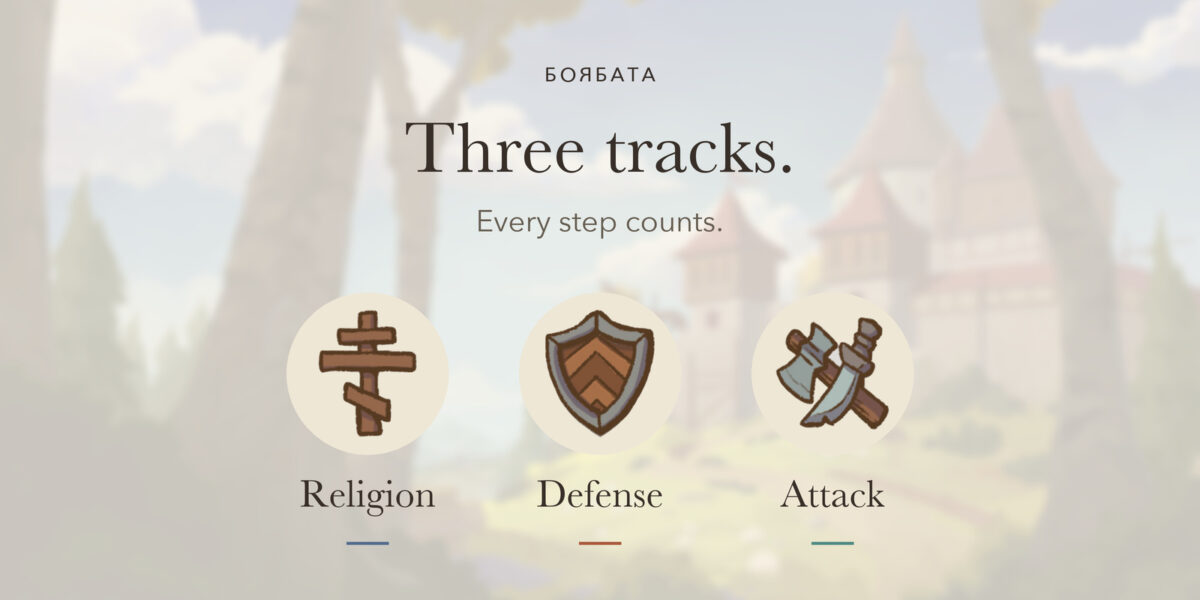
In БОЯБАТА (Borbata), you build a city in a time of Ottoman invasions. You gather materials for your fort and try to score the most points. Each round, you choose a die from the roll: will you keep working on a tower, collect goods for trade or strengthen your city against the next invasion?
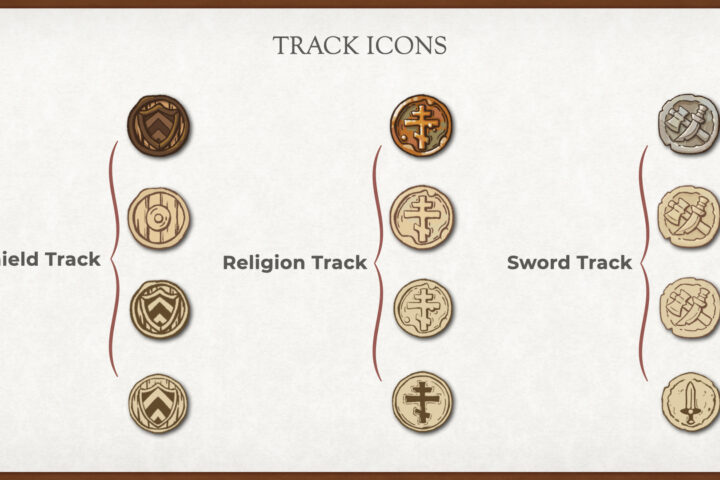
Alongside your fort, your player board has three tracks: religion, defense and attack. You mark your progress on these tracks with tokens showing crosses, shields or swords. Crosses score points, shields fend off invasions and swords drive out Ottomans. That makes each step a decision: what do you use now, and what do you save for later?
During the build phase, a cross, shield or sword on your chosen die advances you along the matching track. Place a token on the next space with its unused side facing up. If you cover a bonus symbol, you may take the corresponding bonus action immediately. This might give you building materials or food, for example. A used token stays on its space: you flip it, but keep your progress.
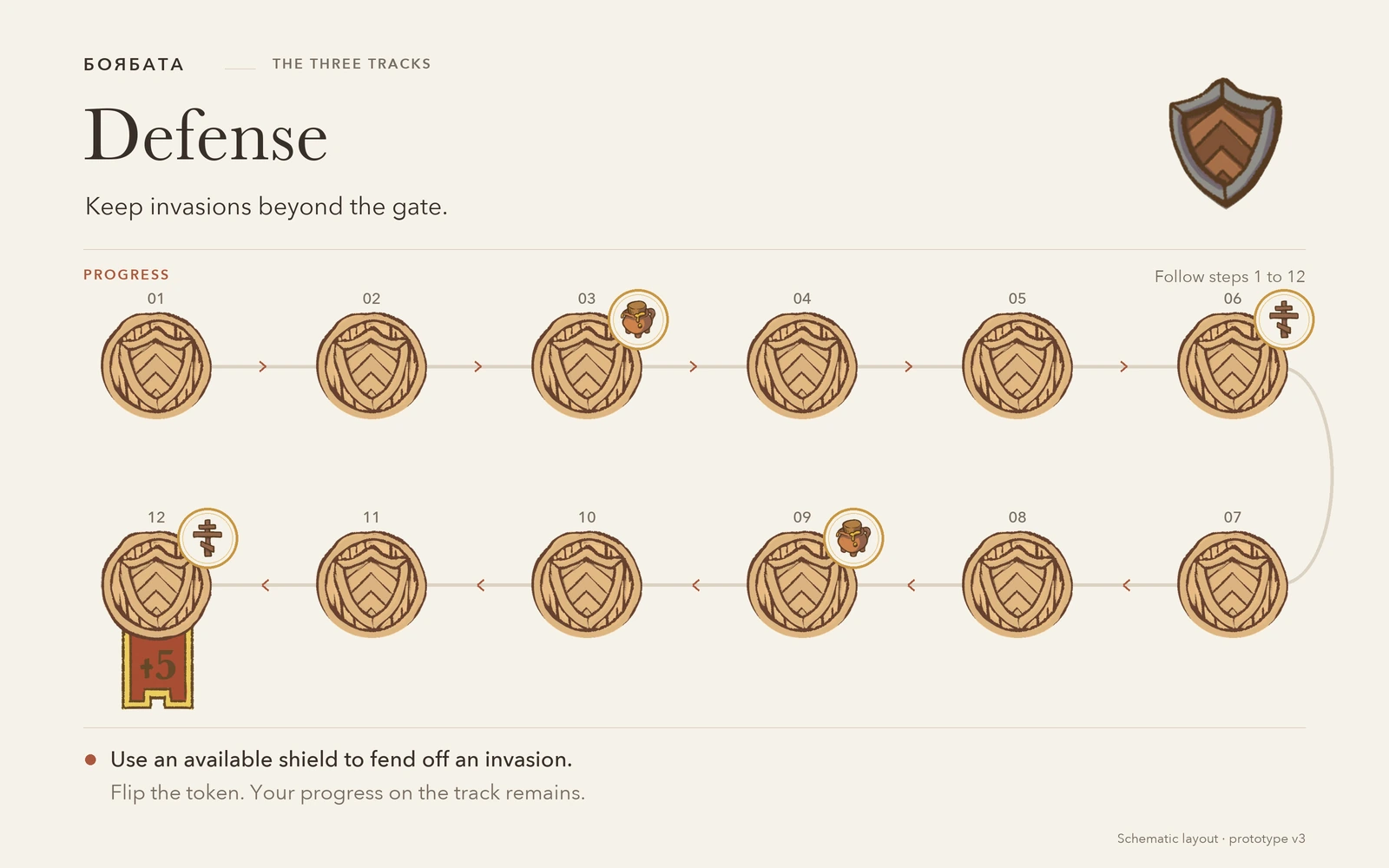
The Ottoman invasion is resolved before the raid and before the build phase. When an Ottoman invades your land, you can flip an unused shield to fend it off. If you have no shield available, place one Ottoman on your player board. It can cause extra losses in the raid that follows.
A shield you collect during the build phase therefore protects you against a future invasion. You can use shields while still working toward the 5 bonus points for completing the track.
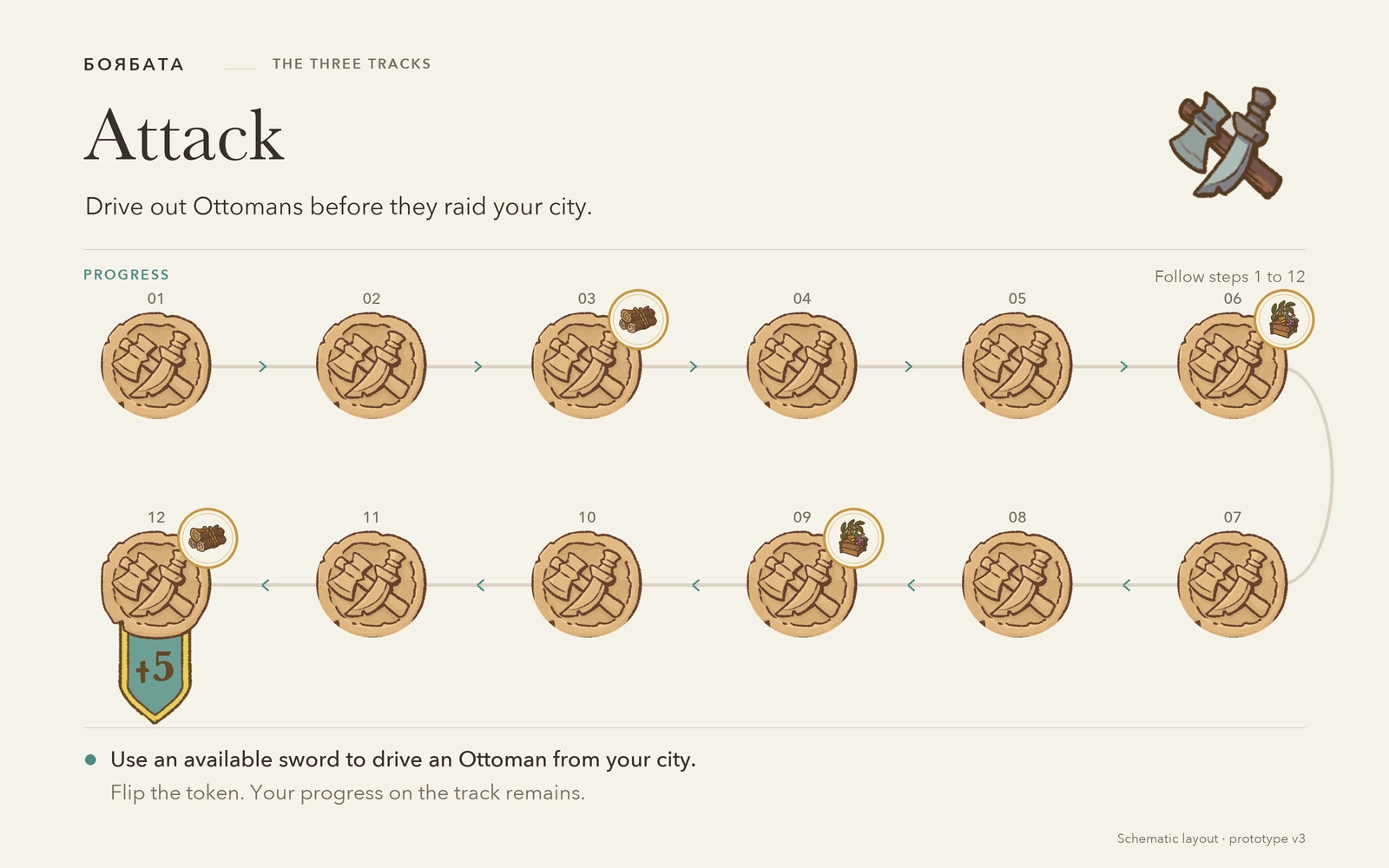
During your turn, you can spend unused swords to drive Ottomans out of your city. Each sword you flip removes one Ottoman. If you reduce the number of Ottomans on your board from two to one, a future raid costs you one fewer possession, as long as no new Ottoman arrives. Attack therefore helps you keep your food and cross tokens.
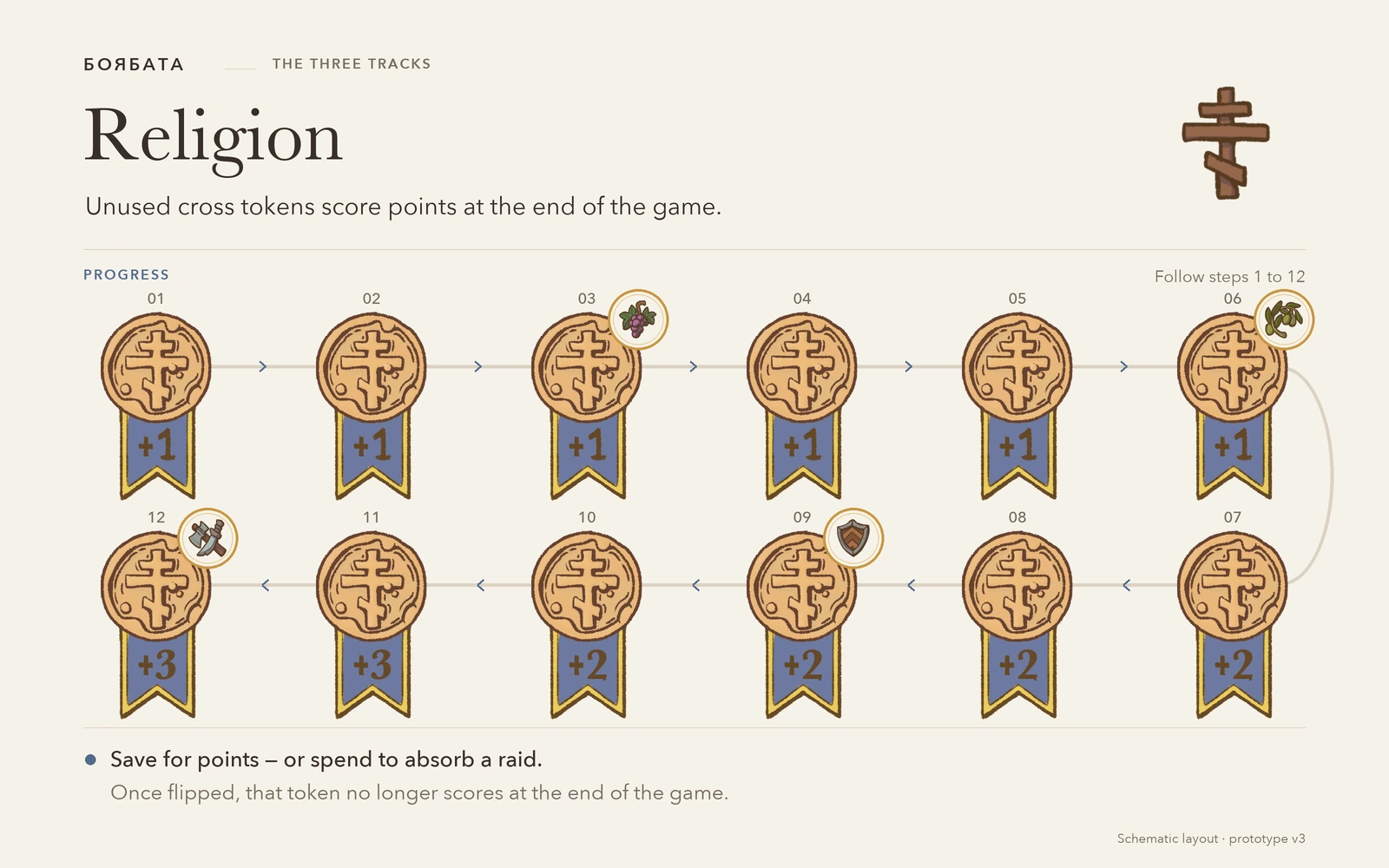
On the religion track, each unused cross token scores the points shown on its space at the end of the game. Later spaces are worth more: after six steps, each new cross scores 2 points instead of 1; the last two spaces are worth 3 points each.
If you have marked the first eight spaces and left all the tokens unused, they are worth 10 points in total. Flip a token on a 1-point space during a raid and you have 9 points left. Choose a 2-point space instead and you have 8 left. In both cases, eight spaces remain marked. Which token you use therefore makes a difference to your score.
During a raid, you give up one possession for each Ottoman on your board: one food item or an unused cross token that you flip. With no Ottomans, you do not have to give anything up.
Giving up food preserves your cross tokens and their points, but may cost you a trading set for building materials. Using a cross saves your food, but leaves you with fewer points at the final scoring. You choose which plan to protect.
The final stage begins when a player ends their turn with every space on any one of the three tracks marked or their fort completed with all eight structures. Play then continues until it is the original starting player’s turn to roll again.
For example, if you have marked eleven spaces on your attack track, the twelfth token also starts the final stage. Before taking that step, you might want to finish another structure or collect a valuable cross. Your choice of die therefore also helps determine how much time remains.
The illustrations show the tracks from the current prototype in a schematic layout. Artwork, symbols, values and rules may still change as development continues.

Tom van der Spek is co-founder of Van der Spek Sons Publishing, an independent board game publisher from the Netherlands. Together with his brother Robert, he works on creating and publishing engaging tabletop games, with Borbata as their upcoming title.


Leave a Reply